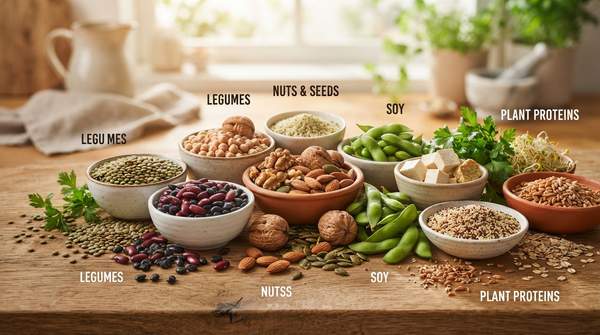
Swapping animal protein for plant protein lowers all three of the big environmental pressures of food production at once: greenhouse gas emissions, land use, and water consumption. A review of diets' environmental impacts reports that producing one kilogram of beef can generate up to 60 kilograms of CO2-equivalent, while producing one kilogram of legumes generates less than one. The practical advantage for eaters is that plant proteins come in four approachable categories — legumes, soy products, nuts and seeds, and whole grains — and each carries its own environmental story, from nitrogen-fixing soil restoration to simply needing a fraction of the land and water that animal farming demands.
Understanding the Environmental Impact of Food Choices
When scientists measure what your food costs the planet, they typically weigh three things. Greenhouse gas emissions capture the climate footprint of production — the methane, nitrous oxide, and carbon dioxide released along the way. Land use measures how much ground is occupied or degraded to grow feed and raise animals. Water use counts both what crops and livestock drink and what production pollutes. The global food system, a review of sustainable diets notes, contributes to greenhouse gas emissions, land degradation, and water pollution all at once.
Those pressures are not evenly distributed across dinner plates. The same review finds that current eating habits have a disproportionately large environmental impact in wealthy nations, where diets high in animal products typically carry higher emissions, more land use, and more demanding water requirements than plant-based diets. It also flags a widening problem: as Western-style eating patterns spread through low- and middle-income countries, driven by global supply chains and market-driven consumption, ecological deterioration accelerates there too. In other words, the protein choices made in industrialized countries set a template the rest of the world is starting to follow.
Plant-Based Proteins: A Sustainable Alternative
The core comparison is stark. The beef-versus-legumes figure — up to 60 kilograms of CO2-equivalent per kilogram of beef against less than one for legumes — comes from research cited in a review of the environmental impact of different diets, and it spans a roughly sixtyfold difference in climate impact for the same weight of food. Plant-based diets generally leave lower environmental footprints than meat-heavy ones across emissions, land, and water, the review concludes, while still supporting healthy nutrition.
World Animal Protection makes the same case from the consumption side, reporting that foods like beans, lentils, tofu, nuts, and seeds use far less water and land and produce a fraction of the emissions of animal products, particularly those from factory farming. The organization also emphasizes that the shift does not have to be absolute: "you don't need to be 100% vegan to make a difference. Every plant-based meal counts." On processed meat alternatives, its view is measured — not all are perfect, but most still come out well ahead of traditional meat in environmental impact. Writing on agricultural sustainability, the InBestSoil project adds that, according to the European Environment Agency, transitioning to plant-based diets can significantly reduce a person's ecological footprint.
Plant Protein Environmental Impact Framework
The framework below maps each environmental metric — and each plant protein category — to its documented advantage over animal protein. Use it as a decision matrix: pick the impact you most want to reduce, or the category whose benefit fits your cooking, and you have a reasoned basis for the choice rather than a generic "plants are better" slogan.
| Impact metric or category | Animal-based comparison | Plant-based advantage |
|---|---|---|
| Greenhouse gas emissions | Beef production can emit up to 60 kg of CO2-equivalent per kg of meat | Legume production emits less than 1 kg per kg; beans, lentils, tofu, nuts, and seeds produce a fraction of animal-protein emissions |
| Land use | Animal agriculture, including factory farming, requires massive amounts of land | Common plant proteins use far less land, helping protect forests and biodiversity |
| Water use | Animal products carry more demanding water requirements | Plant proteins such as beans, lentils, and tofu use far less water |
| Legumes (lentils, beans, peas) | Require synthetic fertilizer inputs in conventional rotations | Fix atmospheric nitrogen, improving soil structure and fertility and reducing the need for synthetic fertilizers |
| Soy products (tofu, tempeh, edamame) | Replaces meat and dairy with a lower-impact protein | Share the general plant-protein advantage of lower water use, land use, and emissions |
| Nuts and seeds (almonds, chia, hemp, sunflower seeds) | Replaces animal protein with a lower-impact option | Use far less water and land and produce fewer emissions than animal proteins |
| Whole grains (quinoa, brown rice, oats) | Replaces animal protein with a lower-impact option | Among the popular plant protein sources sharing the category's lower water, land, and emissions profile |
One boundary matters when reading this table. The headline figures compare plant proteins with animal proteins, not plant proteins with one another, and real-world footprints shift with farming practices, processing, and transportation — variations this category-level view does not capture. No single plant protein can be crowned definitively "most sustainable" on these figures; what they support is the direction of the choice, not a ranking within it.
Categorizing Plant Proteins and Their Unique Benefits
Legumes stand apart for a reason that happens underground. As InBestSoil explains, growing protein crops such as legumes improves soil structure and fertility because of their ability to fix nitrogen from the atmosphere. That fixed nitrogen reduces the need for synthetic fertilizers, which cuts the environmental burden at two points: the industrial production of fertilizer itself, and the runoff that pollutes waterways when excess fertilizer leaves fields. A lentil or pea crop, in other words, quietly rebuilds the soil it grows in while demanding little of it.
The other categories earn their place through the general plant-protein profile rather than a single distinctive mechanism. Soy products — tofu, tempeh, and edamame — deliver a versatile, protein-dense replacement for meat and dairy while using far less water and land and producing fewer emissions, as World Animal Protection reports. Nuts and seeds, from almonds to chia, hemp, and sunflower seeds, offer the same advantage in a form that travels well from pantry to plate. Whole grains such as quinoa, brown rice, and oats round out the list of popular sources, sharing the category's lower demands on water, land, and the climate. Together they give a cook four distinct entry points into the same environmental win.
Choosing Sustainable Protein: A Path Forward
The decision this evidence supports is straightforward: prioritize plant-based protein sources, especially legumes, nuts, seeds, and soy products, to significantly reduce individual dietary environmental footprints. You do not need a perfect record to move the needle — every plant-based meal counts, as World Animal Protection puts it — and legumes offer the added dividend of soil health through nitrogen fixation.
The outcome is measurable rather than abstract: reduced personal greenhouse gas emissions, water consumption, and land use associated with food choices, reflected in dietary tracking or environmental impact calculators. A reasonable way to start is to log a typical week of meals, replace the animal-protein portions with one or two categories from the framework — lentils in a stew, tofu in a stir-fry — and recalculate. The gap between the before and after numbers is the footprint you no longer leave behind.