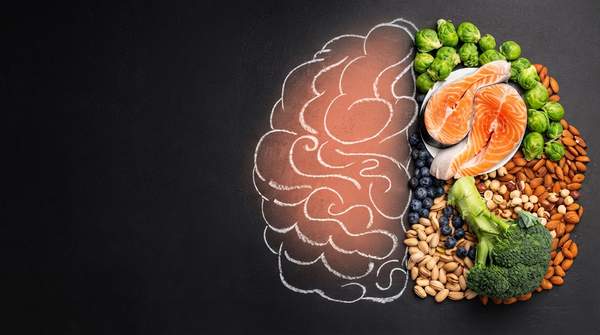
The parts of your meal you cannot digest become the raw material for a chemical conversation with your brain. When dietary fiber reaches the colon, gut bacteria ferment it into short-chain fatty acids (SCFAs) — chiefly butyrate, propionate, and acetate — which a 2026 review in Frontiers in Nutrition by Yupeng Lai and colleagues describes as primary signaling agents of the microbiota-gut-brain axis. These molecules act on receptors in the gut, enter circulation, engage the vagus nerve, modulate immune signaling, and — on preclinical evidence — may cross the blood-brain barrier to act on brain cells such as microglia and astrocytes. The result is a documented influence on neuroinflammation, mood-related biology, and cognitive function, though the precise mechanisms remain an active research frontier.
From Fiber to Fatty Acids: The Production of SCFAs
Production begins with a structural fact of human digestion: we lack the enzymes to break down non-digestible carbohydrates, so dietary fiber arrives in the colon intact. There, it becomes fuel for bacterial communities equipped to ferment it. A scientific review of gut microbiota-derived SCFAs and depression identifies these molecules as the primary metabolites of the gut microbiota, produced via saccharolytic fermentation of non-digestible carbohydrates.
Science writer Kristina Campbell, covering the topic for Gut Microbiota for Health, captures the scale of what happens next: SCFAs are "molecules produced by bacteria when they ferment dietary components (primarily fibre: non-digestible carbohydrates) inside the colon." Some stay close to home — their main purpose, she notes, is serving as an energy source for cells lining the colon — while others travel throughout the body, taking part in interactions that produce wide-ranging health effects.
The signaling capacity of these molecules is built into their chemistry. SCFAs are natural ligands for free fatty acid receptors 2 and 3 (FFAR2/3), which are widely distributed on enteroendocrine, immune, and neural cells. That receptor distribution matters for everything that follows: it means a fiber-derived molecule can be sensed by hormone-releasing gut cells, by immune cells, and by neurons — three audiences with direct lines to the brain.
Key Players: Butyrate, Propionate, and Acetate
Although the three main SCFAs share a production route, they are not interchangeable. Each carries a distinct profile of mechanisms and downstream effects on brain function, which is why researchers treat them separately rather than as a single "fiber benefit."
| SCFA | Production Source | Primary Mechanisms of Action | Impact on Brain Health and Function |
|---|---|---|---|
| Butyrate | Gut bacterial fermentation of dietary fiber (a primary metabolite of saccharolytic fermentation) | Enhances gut barrier integrity; anti-inflammatory properties; inhibits histone deacetylases (HDACs), producing epigenetic changes | Influences gene expression related to neuronal plasticity and the stress response; modulates neuroinflammation and oxidative stress — effects implicated in mood disorders |
| Propionate | Gut bacterial fermentation of dietary fiber (a primary metabolite of saccharolytic fermentation) | Linked to satiety signaling and glucose homeostasis; modulates neuroinflammation and oxidative stress | Affects neurotransmitter levels such as serotonin and dopamine — an effect observed in animal models |
| Acetate | Gut bacterial fermentation of dietary fiber (a primary metabolite of saccharolytic fermentation) | Can be converted to acetyl-CoA, a precursor for neurotransmitters; influences lipid metabolism; utilized by astrocytes for glutamine synthesis | Provides building blocks that brain-supportive cells use in neurotransmitter-related chemistry |
Butyrate stands out for its epigenetic reach: by inhibiting HDACs, it can alter which genes are expressed — including genes tied to neuronal plasticity and the stress response. Propionate's links to satiety and glucose homeostasis connect gut chemistry to whole-body regulation, while its effects on serotonin and dopamine come with an important caveat: those observations come from animal models, not confirmed human measurements. Acetate, the most abundant of the three, contributes raw material — acetyl-CoA — that feeds into neurotransmitter synthesis and is used by astrocytes to make glutamine.
The Journey of Gut Metabolites to the Brain
Readers can trace the complete pathway as a sequence of six stages, each grounded in the reviewed evidence. Following one strand of dietary fiber through the chain shows how a food component becomes a neuroactive signal:
- Dietary fiber intake. Non-digestible carbohydrates are eaten and pass through the small intestine unabsorbed, arriving in the colon as substrate for bacterial fermentation.
- Microbial fermentation and SCFA production. Colonic bacteria perform saccharolytic fermentation, releasing butyrate, propionate, and acetate — the primary metabolites of the gut microbiota.
- Local and systemic action. Some SCFAs serve as energy for colon cells and act locally; others are absorbed into systemic circulation, where they can interact with immune cells and influence the integrity of both intestinal and blood-brain barriers.
- Signaling en route. Circulating and gut-local SCFAs engage the vagus nerve and immune pathways, relaying information to the brain without the metabolites themselves needing to travel the full distance.
- Crossing the blood-brain barrier. Preclinical evidence suggests certain microbial metabolites may cross the blood-brain barrier and act on central neurotransmitter systems — though direct human effects remain poorly characterized, as Nicola Johnstone and Kathrin Cohen Kadosh caution in their Molecular Psychiatry review of empirical evidence for the gut-brain axis.
- Action on brain cells. Within the central nervous system, SCFAs act on cells such as microglia and astrocytes, modulating neuroinflammation, oxidative stress, and gene expression — with downstream implications for mood regulation and cognitive function.
The value of this sequence is that it makes the causal chain explicit: no single step is mysterious, and each stage is where diet, microbiology, and neuroscience hand off the signal to one another.
Pathways of Communication: How SCFAs Reach the Brain
The gut-brain connection is not a single road but a network. A review of the role of SCFAs in gut-brain communication notes that microorganisms can influence central nervous system processes bidirectionally via the vagus nerve, through modulation of the immune system, the hypothalamic-pituitary-adrenal (HPA) axis, and tryptophan metabolism — alongside their capacity to synthesize neurotransmitters and produce metabolites such as SCFAs that possess neuroactive properties.
The vagal route has some of the strongest empirical footing. One review of gut microbiota metabolites and brain function points out that vagotomy affects brain functions and that vagus nerve stimulation modulates mood and behavior, concluding that the enteric nervous system–vagus–brain pathway is likely one of the main mechanisms of gut-brain axis communication. Gut-derived metabolites can interact with the enteric nervous system directly, or activate it indirectly through the enteroendocrine function of colonic enterochromaffin and L cells.
Signaling can also be initiated peripherally — via immune routes in the body — or after metabolites translocate into the central nervous system. The same review emphasizes that certain metabolites can have beneficial or detrimental effects depending on the pathway of action and the disease model, a reminder that these molecules are signals, not universally benign supplements.
SCFA Action on Brain Cells and Functions
Once signals arrive, the brain's resident immune and support cells are the working end of the pathway. Microglia — the brain's immune cells — and astrocytes respond to SCFA-mediated signaling, and the resulting shifts in neuroinflammation and oxidative stress are central to how researchers explain microbiome effects on mood and cognition. Butyrate's HDAC inhibition gives it a direct route into gene expression relevant to neuronal plasticity and stress response.
The clinical relevance of this cell-level picture appears in observational data on depression. A review published in Life reports that results from observational studies suggest major depressive disorder is associated with an increased occurrence of proinflammatory microbial strains alongside a decreased relative abundance of SCFA-producing bacteria. The SCFAs-and-depression review reaches a parallel conclusion: SCFAs act as essential mediators in the microbiota-gut-brain axis and play a vital role in the neurobiological mechanisms of depression.
These findings describe associations and mechanisms, not proven treatments. The evidence base mixes preclinical work, animal models, and human observational studies, and the field is still mapping which SCFA effects translate intact from mice to people — particularly for the blood-brain barrier crossing, where human data remain thin.
Empowering Brain Health Through Dietary Choices
The decision this evidence supports is straightforward: prioritizing a diet rich in fermentable dietary fiber is a foundational step to support a healthy gut microbiome and, consequently, brain health through SCFA production. The pathway is mechanistically plausible at every stage — fiber feeds bacteria, bacteria produce butyrate, propionate, and acetate, and those molecules signal through receptors, the vagus nerve, immune modulation, and possibly the blood-brain barrier itself.
What readers can watch for as the field matures is the measurable indicator researchers and individuals alike track: improved mood stability, enhanced cognitive clarity, and a reduction in symptoms associated with neuroinflammation, as reported in personal well-being or observed in future research outcomes. This article explains mechanisms as understood from scientific research and does not constitute medical advice or treatment recommendations; other metabolite classes, such as tryptophan derivatives and bile acids, are acknowledged but sit outside this SCFA-focused account. The next milestones to watch are human studies that move the blood-brain barrier question from preclinical suggestion to direct characterization — the link in the chain currently least established.
Sources
- Frontiers | Microbial metabolites at the nexus of gut-brain communication and neurodevelopmental disorders
- Gut microbiota-derived short-chain fatty acids and depression — PMC
- Breaking it down: Short-chain fatty acids and your health — Gut Microbiota for Health
- The Role of Short-Chain Fatty Acids From Gut Microbiota in Gut-Brain Communication - PMC
- Tandfonline