Nutrients often deliver more benefit eaten together than alone. When certain vitamins, minerals, or phytonutrients are consumed in combination, they can have a more powerful effect on health than when eaten separately—a concept called nutrient synergy, as Stacey Colino explained in National Geographic in 2023. In some pairings, one nutrient improves the body's ability to absorb another; in others, the nutrients produce additive effects. The practical payoff is concrete: with a few deliberate combinations, such as adding olive oil to vegetables or vitamin C-rich foods to iron-rich plants, you can meaningfully increase how much of those nutrients your body actually uses.
How Nutrients Work Together: Key Synergistic Mechanisms
The science of nutrient synergy stands apart from the traditional "reductionist" approach of studying one vitamin or mineral at a time. "It's always existed but we're just discovering the importance of nutrient synergy—the idea that the whole is more impactful than the sum of its parts," says Keith Ayoob, a dietitian in New York City and associate professor emeritus of pediatrics at the Albert Einstein College of Medicine. "With nutrient synergy, when you combine nutrients in the proper amounts, they're more useful to the body than either one is by itself."
Researchers frame the same idea at the level of meal design. "Rather than looking at the nutrition of foods on their own, we can learn how to combine them to optimize their beneficial effects," says Maryam S. Makowski, a certified nutrition specialist and clinical associate professor at Stanford University. Certain food combinations, she notes, can help increase the absorption of important nutrients or boost the effectiveness of their antioxidants.
Not all synergy works the same way, and the differences matter for how you plan a plate. Broadly, the well-documented interactions fall into a few distinct biochemical patterns. Some improve solubility and uptake: fat-soluble vitamins need dietary fat to be absorbed efficiently. Some enhance chemical conversion: vitamin C chemically transforms iron into a form the intestine can take up. And some direct nutrients to the right tissues: vitamin K helps guide calcium toward bone rather than letting it deposit elsewhere. Understanding which mechanism is at work tells you why a pairing helps—and which foods to combine.
The clearest mechanistic example comes from iron research. A collaborative team led by Dr. Hitomi Sawai of the University of Hyogo and Dr. Hiroshi Sugimoto of the RIKEN SPring-8 Center solved the molecular structures of a key membrane protein involved in dietary iron absorption in the human duodenum, revealing for the first time how vitamin C enhances iron absorption at the atomic level. Dietary iron is absorbed on the duodenal villi, and vitamin C—as ascorbic acid—acts as a reducing agent, converting ferric iron (Fe3+) into the more soluble, absorbable ferrous form (Fe2+). That chemical transformation is what makes non-heme iron from plant foods, which is normally less bioavailable than the heme iron in meat, far more available to the body.
Synergistic Food Pairings: Mechanisms and Examples
The table below classifies the best-supported pairings by their underlying mechanism, so you can see not just what to combine but why the combination works. Each row reflects a distinct pattern of interaction—improved absorption through fat, chemical conversion, or tissue-targeting—drawn from the evidence above.
| Nutrient Pair | Synergistic Mechanism | Food Combination Examples |
|---|---|---|
| Healthy fats + fat-soluble vitamins (A via carotenoids, E, K) | Fats facilitate the transport and uptake of fat-soluble vitamins in the digestive system, enhancing their bioavailability—how well the body absorbs and uses a nutrient. | Olive oil drizzled over vegetables; avocado paired with leafy greens. Vitamins K and E and carotenoids are better absorbed when paired with a healthy fat source. |
| Vitamin D + calcium + vitamin K | Vitamin D enhances intestinal calcium absorption, while vitamin K2 helps direct calcium to bone tissue rather than soft tissues, supporting skeletal integrity. | Yogurt with berries; calcium-rich foods such as milk or cheese combined with vitamin K sources such as leafy greens. |
| Vitamin C + non-heme iron | Ascorbic acid acts as a reducing agent, converting ferric iron (Fe3+) to the more soluble, absorbable ferrous iron (Fe2+) in the intestine—making plant-based iron readily available for uptake. | Vitamin C-rich produce eaten alongside iron-containing plant foods at the same meal. |
Two boundaries are worth noting. The fat-soluble-vitamin mechanism is explicitly supported for vitamins A (via carotenoids), E, and K in the evidence cited here; vitamin D follows a different pathway, working with calcium and vitamin K as described in the second row. And the food examples above illustrate each mechanism rather than exhaust it—many other combinations can serve the same purpose.
Applying Nutrient Synergy for Optimal Health
Turning these mechanisms into meals requires only modest planning. "Thinking about grabbing a handful of, say, grapes or nuts is okay, but there might be a benefit to a little more planning—creating snack pairings or having a meal with a few components, versus eating each one alone," says Oliveira, quoted in Harvard Health. "You'll get a variety of nutrients, but you may also improve the absorption of vitamins, and you might feel much more satisfied for longer."
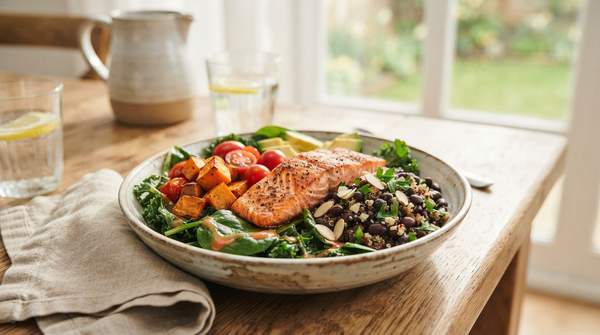
In practice, that means building each meal around at least one mechanism. A salad of leafy greens with olive oil and avocado leverages fat-facilitated absorption of vitamins K and E and carotenoids. A breakfast of yogurt with berries, or a lunch pairing cheese or milk with a leafy-green side, brings calcium together with the vitamins that help absorb and direct it. Adding vitamin C-rich produce—such as citrus or berries—to an iron-containing plant dish engages the ferric-to-ferrous conversion that the SPring-8 research team documented at the molecular level.
These combinations are also a reminder of why whole foods and varied meals tend to outperform isolated single nutrients. The synergy concept holds that nutrients "in the proper amounts," as Ayoob puts it, are more useful to the body than either one alone—which is an argument for dietary variety rather than for any single superfood. It is also, importantly, a general principle rather than a treatment: this information supports everyday meal planning and is not a substitute for personalized medical advice, particularly for anyone managing a deficiency or an underlying condition.
Finally, note what this framework deliberately leaves out. It covers synergistic—beneficial—interactions only. Nutrients can also compete with or inhibit one another, and a comprehensive guide to those antagonistic interactions is beyond this article's scope; the pairings above are the well-evidenced positive cases.
Making Synergy a Habit: Practical Steps for Your Diet
The decision is simple: integrate synergistic food pairings into daily meals to enhance nutrient absorption and overall health. You don't need to memorize biochemistry—just keep the three mechanisms in mind and let them shape ordinary choices: add a healthy fat when you eat colorful vegetables and greens, pair calcium-rich dairy with vitamin K sources, and put vitamin C foods on the plate with iron-rich plants. A measurable way to check whether the habit has taken hold: regularly observe the inclusion of at least two synergistic food pairings in your daily dietary choices. Hit that mark consistently, and you'll be applying nutrient synergy the way the research suggests it works best—as a routine feature of whole, varied meals rather than an occasional trick.