Plant foods protect cells through several distinct biochemical strategies, not one generic "antioxidant" effect. Three major classes of phytochemicals—polyphenols, carotenoids, and glucosinolates—work in fundamentally different ways: polyphenols primarily modulate the cellular signaling pathways that govern inflammation and stress responses, carotenoids provide direct antioxidant protection against ultraviolet radiation and oxidative damage, and glucosinolates activate the cell's own detoxification enzymes through their breakdown products. Understanding these differences explains why dietary variety matters more than loading up on any single "superfood," and it gives you a concrete way to choose plant foods that target the cellular mechanisms you care about.
Polyphenols: Modulating Cellular Signaling and Antioxidant Defense
Polyphenols are the most versatile of the three classes, and much of their power comes from their dual role. On one hand, they contribute antioxidant activity, helping to reduce the oxidative stress that damages cellular components. On the other—and this is where their behavior departs from the simple "free-radical scavenger" picture—they interact with the signaling networks that determine how a cell responds to its environment.
Reviews of plant-derived bioactive compounds map specific polyphenols to specific pathways. EGCG from green tea acts on the PI3K/Akt, NF-κB, PKC, MAPK and JNK pathways. Curcumin from turmeric acts on NF-κB, PI3K/Akt and JAK/STAT. Resveratrol, found in grapes, acts on the SIRT1/PGC-1α pathway along with PI3K/Akt, NF-κB and VEGF. The significance of these pathway names is that they are the cell's control circuits: NF-κB is a central regulator of inflammatory responses, and SIRT1 influences mitochondrial biogenesis and cellular aging.
The concrete consequences reported for these interactions include reduced pro-inflammatory cytokines, suppression of microglial activation, protection of neural cells from oxidative stress, and enhanced mitochondrial biogenesis through SIRT1 activation. A review of plant-food bioactive components reports an even broader chain of effects for grape polyphenols: experimental data suggest they can lower atherosclerosis risk by reducing LDL oxidation, and that reduced oxidative stress then affects the cellular redox state by decreasing inflammation, regulating endothelial functions, preventing cell senescence, hindering platelet aggregation, and reducing blood pressure.
What most distinguishes polyphenols from conventional drugs is their breadth. As researchers writing in Frontiers in Nutrition put it, unlike conventional single-target drug therapies, plant-derived compounds "typically exhibit multi-target effects, simultaneously regulating multiple physiological processes." Their effects vary across tissues and are influenced by dosage and individual factors—so a finding in one tissue cannot simply be generalized to the whole body.
Carotenoids: Direct Antioxidant Power and Cellular Protection
Carotenoids represent a more direct protective strategy. These pigments are present in plants, often contributing to their color—carrots, tomatoes and leafy greens are familiar examples—and reviews of phytonutrients describe their role in lowering oxidative stress and inflammation and providing protection from ultraviolet radiation, alongside effects on signaling pathways.
Beta-carotene illustrates the class well. Reviews report that it is helpful in preventing night blindness and age-related macular degeneration. That benefit is specific to beta-carotene as a type of carotenoid, not a property of the entire class, which is exactly the kind of distinction that matters when translating compound science into food choices.
The broader lesson from the carotenoid evidence is that "protection" here means shielding cells from incoming damage—ultraviolet radiation being the clearest example—rather than reprogramming internal pathways the way polyphenol signaling does. Both strategies reduce the same upstream problem, oxidative stress, but they attack it from different ends: one by intercepting the stressors, the other by adjusting how the cell responds to them.
Carotenoids also highlight a practical point that runs through this whole field: the compound and the food are not interchangeable. A review of bioactive compounds emphasizes that clinical effectiveness depends on bioavailability, food matrix, gut microbiota composition, and individual host characteristics. The same molecule delivered in a tomato and delivered in a capsule may not behave identically in the body.
Glucosinolates: Activating Detoxification Pathways
Glucosinolates take a third, structurally different approach. Found primarily in cruciferous vegetables—broccoli, cabbage and kale are representative examples—they are credited with potential anticancer properties, and those properties are primarily mediated by their breakdown products rather than by the intact compounds.
When glucosinolate-containing plants are damaged—by chopping, chewing or processing—the glucosinolates hydrolyze into isothiocyanates. These breakdown products are what activate detoxification enzymes, the cell's internal machinery for neutralizing and eliminating harmful compounds. In other words, the plant delivers a precursor, and the enzymatic defense is built inside the cell only after breakdown occurs.
This makes glucosinolates the clearest counterexample to the generic "antioxidant supplement" framing. The protective work is done neither by a single molecule nor by a simple chemical reaction, but by an activation sequence: precursor, breakdown, enzyme induction, detoxification. It also means that the practical question of food preparation is not incidental for this class, since the pathway to the active compounds depends on disrupting the plant's own structure.
The same review that details glucosinolate chemistry draws a boundary that applies to all three classes: incorporating foods naturally rich in bioactive compounds should be strongly encouraged as part of healthy dietary patterns, while isolated supplements or concentrated extracts should be based on consistent clinical evidence and individualized to a person's context.
Comparative Framework: How Plant Compounds Protect Your Cells
Reading the three classes side by side shows why no single food or compound can cover all the cellular bases. The table below classifies polyphenols, carotenoids and glucosinolates by their dominant mechanism, a representative cellular outcome, and their rich food sources, using the findings cited throughout this article.
| Compound Class | Primary Mechanism of Action | Example Cellular Outcome | Rich Food Sources |
|---|---|---|---|
| Polyphenols | Antioxidant activity plus modulation of cellular signaling pathways (NF-κB, SIRT1/PGC-1α, PI3K/Akt) | Reduced pro-inflammatory cytokines; regulated endothelial function; reduced LDL oxidation and cell senescence | Grapes, berries, green tea (representative examples, not exhaustive) |
| Carotenoids | Direct antioxidant activity; protection from ultraviolet radiation; effects on signaling pathways | Beta-carotene helps prevent night blindness and age-related macular degeneration | Carrots, tomatoes, leafy greens |
| Glucosinolates | Hydrolysis into isothiocyanates, which activate detoxification enzymes | Activation of cellular detoxification pathways with potential anticancer properties | Cruciferous vegetables: broccoli, cabbage, kale |
The comparison yields a clear conclusion: the three classes offer complementary, not redundant, forms of cellular protection. Polyphenols adjust the cell's stress-response and inflammatory circuits, carotenoids intercept incoming damage such as UV radiation, and glucosinolates prime detoxification enzymes through their breakdown products. A diet built around only one of these strategies leaves the other two cellular pathways unaddressed.
Two qualifications from the underlying science should travel with this framework. Effects vary across tissues and are influenced by dosage and individual factors, and the food sources listed are representative examples rather than an exhaustive inventory. The same review also stresses the role of bioavailability, food matrix and gut microbiota composition in determining real clinical effectiveness—factors this article can flag but not fully break down for every compound.
Making Informed Dietary Choices for Cellular Health
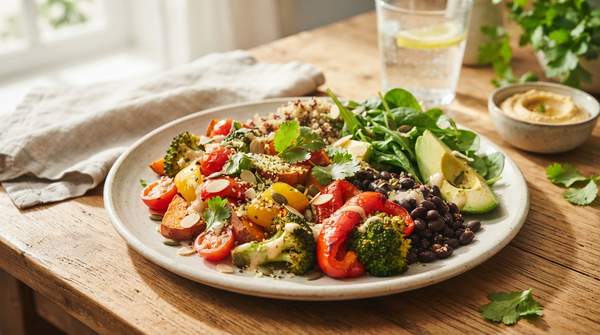
The decision this framework supports is to integrate a wide variety of plant-based foods into your diet to leverage the distinct and complementary cellular protective mechanisms of polyphenols, carotenoids, and glucosinolates. Translated into foods, that means a weekly pattern that includes berries, grapes or green tea for polyphenol signaling; carrots, tomatoes or leafy greens for carotenoid protection; and broccoli, cabbage or kale for glucosinolate-derived detoxification support.
A measurable indicator is regular consumption of colorful fruits, leafy greens, and cruciferous vegetables, observed through dietary logs or meal planning. Checking a week's log against the three mechanism columns in the table above is a concrete way to confirm that all three protective strategies—signaling modulation, direct antioxidant protection, and detoxification activation—are represented.
Finally, the boundaries of this framework deserve restating. It explains mechanisms of plant compounds; it is not medical advice or a dietary plan for treating disease. It is limited to polyphenols, carotenoids and glucosinolates as representative bioactive compounds, and it deliberately sets aside vitamins, minerals and fiber. And the evidence itself carries a caution noted in one comprehensive review of dietary phytochemicals: significant gaps remain in understanding their precise mechanisms of action and their long-term effects on health, including variations in bioavailability and efficacy across different populations.