Nutrition

How the Glycemic Index Works: A Complete Guide

The Glycemic Index (GI) provides a powerful framework for understanding how different carbohydrates affect your body's energy. Learn what it is and how to use it to manage blood sugar and make informed food choices.

RP
Ryan Patel

April 7, 2026 · 9 min read

An artistic overhead shot of various healthy foods like berries, oats, and leafy greens on a wooden table, with subtle visual effects representing blood sugar levels.

You have likely experienced the feeling: an hour after a satisfying lunch, a wave of fatigue washes over you, making it difficult to concentrate. This common "afternoon slump" is often linked to a rapid spike and subsequent crash in your blood sugar levels. Understanding the Glycemic Index (GI) provides a powerful framework for explaining this process, offering a scientific lens through which to view how different carbohydrate-containing foods affect your body's energy and hormonal responses.

What Is the Glycemic Index (GI) and How Is It Measured?

The Glycemic Index is a rating system for foods containing carbohydrates, showing how quickly each food affects your blood sugar (glucose) level when that food is eaten on its own. It provides a numerical score, typically on a scale of 0 to 100, that estimates how quickly carbohydrates in a particular food break down during digestion and are absorbed into the bloodstream. Pure glucose is used as the reference point and is assigned a GI value of 100. This tool allows for a more nuanced understanding of carbohydrates beyond simply classifying them as "simple" or "complex."

The measurement of a food's GI value is a standardized clinical process. According to research published in journals like the American Journal of Clinical Nutrition, the GI is determined in vivo, meaning within a living organism. In these tests, participants consume a portion of the food containing exactly 50 grams of digestible carbohydrate. Their blood glucose response is then monitored over the next two hours. This response is plotted as a curve, and the area under that curve is calculated. This result is then compared to the area under the curve produced after the same person consumes 50 grams of pure glucose. The GI value is expressed as the percentage of this ratio, providing a standardized score that can be compared across different foods.

How the Glycemic Index Affects Blood Sugar Levels: A Step-by-Step Process

The Glycemic Index (GI) quantifies how quickly carbohydrates raise blood sugar, dictating the body's metabolic reaction. This speed determines whether foods provide sustained energy or a quick burst followed by a crash.

  1. Step 1: Ingestion and Initial DigestionThe process begins when you eat a food containing carbohydrates. Digestion starts in the mouth, where enzymes in your saliva begin to break down starches. As the food travels to the stomach and then the small intestine, various enzymes continue this process, breaking down complex carbohydrates into their simplest form: glucose. The physical and chemical structure of the food plays a significant role here. Foods high in fiber or fat, for example, tend to slow down stomach emptying and the subsequent digestive process.
  2. Step 2: The Rate of Glucose AbsorptionThis is the critical stage where the Glycemic Index comes into play. Once carbohydrates are broken down into glucose, they are absorbed through the walls of the small intestine and enter the bloodstream. High-GI foods, such as white bread or sugary cereals, are broken down and absorbed very quickly. This causes a rapid and significant influx of glucose into the blood. In contrast, low-GI foods, like lentils, whole oats, or non-starchy vegetables, are digested more slowly. Their glucose is released into the bloodstream at a more gradual, sustained pace.
  3. Step 3: The Pancreatic Insulin ResponseYour body strives to maintain a stable level of glucose in the blood. When it detects a rise in blood glucose after a meal, the pancreas responds by releasing a hormone called insulin. Insulin acts like a key, unlocking your body's cells—primarily in the muscles, liver, and fat tissue—to allow them to absorb glucose from the blood and use it for energy or store it for later use. This action effectively lowers the amount of sugar circulating in your bloodstream.
  4. Step 4: High-GI vs. Low-GI Hormonal ImpactThe speed and magnitude of the glucose spike directly influence the insulin response. A rapid surge in blood sugar from a high-GI food triggers a correspondingly large and rapid release of insulin. While effective at clearing glucose from the blood, this powerful insulin surge can sometimes overcompensate, causing blood sugar levels to fall too low, a condition known as reactive hypoglycemia. This subsequent "crash" is what often leads to feelings of fatigue, hunger, and cravings for more high-carbohydrate foods. Conversely, the slow, steady release of glucose from low-GI foods elicits a more moderate and prolonged insulin response. This helps maintain stable blood sugar levels, providing more sustained energy and better appetite control.


Common Mistakes When Using the Glycemic Index

The Glycemic Index is a valuable tool, but its practical application is often misunderstood. Relying solely on GI numbers without broader dietary context can lead to flawed food choices, hindering health goals.

  • Ignoring Portion Size and Glycemic Load (GL): One of the most significant limitations of the GI is that it does not account for the amount of carbohydrate in a typical serving of food. It only measures the quality, or speed of absorption, of the carbohydrate. This is where a related concept, the Glycemic Load (GL), becomes crucial. The GL integrates both the quality (GI) and the quantity of carbohydrates in a serving. For example, a study in the journal Nutrients notes that watermelon has a high GI of 74, but a standard 100-gram serving contains very little carbohydrate, resulting in a low GL of just 4. Focusing only on its high GI would be misleading. Calculating GL (GI multiplied by grams of carbohydrate, divided by 100) provides a more accurate picture of a food's real-world impact on blood sugar.
  • Equating "Low-GI" with "Healthy": A low GI value does not automatically make a food a healthy choice. Many foods that are high in fat or fructose, like ice cream or potato chips, can have a moderate GI score because fat slows down gastric emptying. However, these foods may be high in calories, saturated fats, and sodium, and offer little nutritional value. It's important to note that the GI is a measure of carbohydrate metabolism, not a comprehensive rating of a food's overall healthfulness. A balanced diet should prioritize whole, minimally processed foods, regardless of their precise GI value.
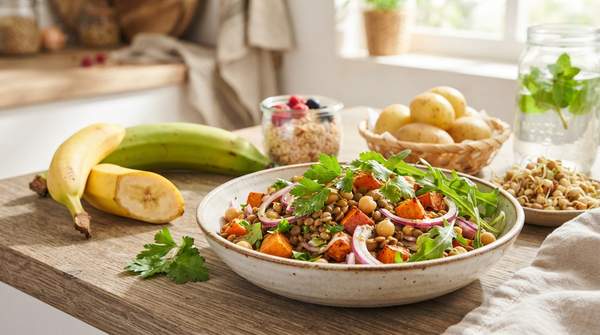
  • Disregarding the Effects of Food Preparation and Ripeness: The GI of a food is not a fixed number; it can be influenced by several factors. Cooking methods can significantly alter the structure of starches, making them easier to digest and thus increasing the GI. For instance, pasta cooked al dente has a lower GI than pasta that is overcooked and soft. Similarly, the ripeness of a fruit affects its sugar content and GI. A green, unripe banana has more resistant starch and a lower GI than a ripe, yellow banana with brown spots.
  • Overlooking the Impact of Meal Composition: Foods are rarely eaten in isolation. The other components of a meal—protein, fat, and fiber—all have a moderating effect on blood sugar response. Consuming a high-GI food, like a baked potato, alongside a source of protein (like chicken) and healthy fats (like avocado) will result in a lower overall GI for the meal compared to eating the potato alone. The fiber from a side of broccoli would further slow digestion and blunt the glucose spike. This underscores the need for balanced meals rather than fixating on the GI of individual ingredients.

Practical Applications of the Glycemic Index for Diet Management

The Glycemic Index has practical applications for managing chronic conditions, optimizing physical performance, and supporting weight management. Used thoughtfully within a comprehensive dietary strategy, its strength lies in shifting focus from carbohydrate quantity to quality.

For individuals with metabolic conditions like prediabetes and type 2 diabetes, low glycemic index and low glycemic load diets are particularly relevant. Research indicates these diets improve key health markers: glycemic control, blood lipids, blood pressure, and Body Mass Index (BMI). By promoting slower, controlled glucose release, low-GI diets reduce pancreatic demand for insulin, improving insulin sensitivity over time. This makes the GI valuable for constructing meals that support stable blood sugar and long-term metabolic health.

In sports nutrition, athletes strategically consume carbohydrates based on their GI to optimize energy and aid recovery. Low-GI carbohydrates an hour or two before a long endurance event provide sustained energy. High-GI carbohydrates are recommended immediately after intense exercise to rapidly replenish depleted muscle glycogen stores, crucial for recovery and preparing for the next training session.

Foods are categorized into three GI ranges to apply these concepts. The table below illustrates these classifications, with values from sources like the Arkansas Heart Hospital serving as a helpful guide.

GI CategoryGI Score RangeCharacteristicsExamples
Low GI55 or lessSlowly digested and absorbed, causing a gradual rise in blood sugar.Rolled oats, lentils, beans, non-starchy vegetables, apples, whole-wheat pasta.
Medium GI56 - 69Digested and absorbed at a moderate pace.Whole-wheat bread, brown rice, sweet potatoes, pineapple, honey.
High GI70 or moreQuickly digested and absorbed, resulting in a rapid blood sugar spike.White bread, corn flakes, baked potatoes, white rice, watermelon, sports drinks.

Frequently Asked Questions

How do I find the Glycemic Index of a food?

The most comprehensive, scientifically validated GI values are in international tables of glycemic index and glycemic load, periodically updated by researchers, according to ScienceDirect. For everyday use, reputable health organizations and universities publish searchable online databases and printable charts for common foods.

Does a low-GI diet help with weight loss?

A low-GI diet can aid weight management by increasing satiety and reducing overall calorie intake. Low-GI foods prevent sharp blood sugar spikes and crashes, regulating appetite and reducing cravings. Some studies report low-GL diets improve BMI. However, long-term weight loss requires a consistent calorie deficit from diet and physical activity.

Is the Glycemic Index the only thing that matters for managing blood sugar?

The Glycemic Index is one piece of the puzzle; Glycemic Load (GL) is often more practical as it accounts for portion size. Meal composition—protein, fat, and fiber content—also crucially impacts blood glucose response. A balanced, whole-foods diet rich in fiber, lean protein, and healthy fats is the cornerstone of effective blood sugar management. Use the GI as a guide for choosing better-quality carbohydrates within this framework.

The Bottom Line

The Glycemic Index is a scientifically validated tool, offering valuable insight into how carbohydrate-containing foods impact blood sugar and highlighting carbohydrate quality as a key factor in metabolic health. To make this actionable, incorporate more low-GI whole foods, considering portion sizes and overall meal balance over a single number.

Identify high-GI staples like white rice or sugary breakfast cereal and swap them for lower-GI options such as brown rice, quinoa, or oatmeal. This dietary adjustment, integrated into a balanced, nutrient-dense diet, can stabilize energy levels and support long-term health.