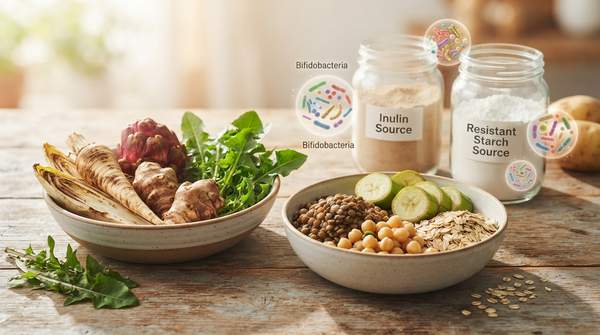
Not all prebiotic fibers do the same job in your gut. The evidence points to a simple but underappreciated fact: inulin selectively enriches Bifidobacterium species, while resistant starch enriches Eubacterium, and the bacteria each fiber feeds determine which metabolic byproducts — and which health effects — follow. Newer preclinical research adds an uncomfortable wrinkle, suggesting that refined inulin supplementation may raise colorectal tumor risk under carcinogenic conditions in mice. Choosing a prebiotic, in other words, is a specific decision, not a generic one.
Beyond Generic Fiber: Understanding Prebiotic Specificity
The classic definition of a prebiotic is a dietary ingredient that nourishes beneficial gut microbes. But the scientific review literature on dietary fiber and the gastrointestinal microbiota makes clear that this nourishment is selective: different fibers feed different taxa. When researchers used molecular methods to track community composition after people consumed fibers in adequate doses, galactooligosaccharides (GOS) and agave inulin primarily and selectively enriched Bifidobacterium species, while resistant starch type 2 (RS2) enriched Eubacterium.
That selectivity has consequences. The same review notes that microbial metabolism results were highly variable, with the same fiber inducing different changes in short-chain fatty acid (SCFA) concentrations depending on the clinical population studied. Fiber structure, in other words, is not just a matter of "more fiber is better" — it determines which organisms flourish and what they produce.
Inulin: Nourishing Bifidobacterium and Emerging Concerns
Inulin is a highly fermentable fructan, widely used both as a prebiotic supplement and as a food additive, and it selectively expands putatively beneficial gut taxa, including Bifidobacterium. These bacteria are considered beneficial residents of the human gut: the Quadram Institute notes that Bifidobacterium's sugar-crunching abilities help it colonize the infant gut quickly after childbirth and start affecting health outcomes early in life, and that its absence in preterm babies is linked to heightened risk of conditions like necrotising enterocolitis.
But a 2026 preclinical study posted as a bioRxiv preprint complicates the tidy "prebiotics are good" narrative. In that work, refined inulin supplementation dramatically elevated colorectal tumor prevalence — roughly 70% — compared with all other fiber-supplemented and control groups, which showed roughly 10–20% tumor prevalence, under conditions where mice were exposed to the carcinogen azoxymethane (AOM). The authors' interpretation is that inulin supplementation preconditions the gut microbiome toward a latent metabolic vulnerability — disrupted fermentation throughput and reprogrammed amino acid metabolism — that carcinogen exposure then amplifies into a tumor-promoting ecosystem.
Two boundaries matter here. First, this is a preclinical mouse study under induced carcinogenic conditions; it cannot be directly extrapolated to humans. Second, the same preprint acknowledges that dietary fiber from whole foods is consistently associated with a reduced risk of colorectal cancer. The concern attaches specifically to refined inulin as an isolated supplement or additive, not to fiber-rich foods generally.