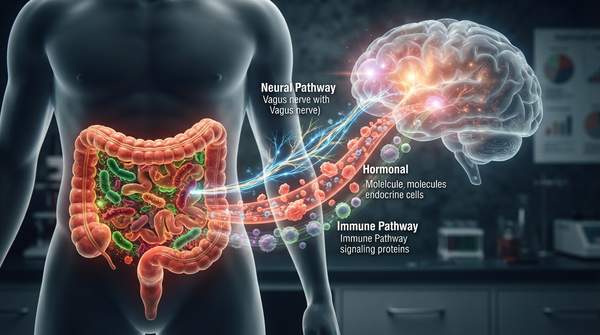
Your gut influences your mood and thinking through three distinct communication channels: a direct neural line via the vagus nerve, a hormonal route centered on the HPA axis, and an immune pathway in which inflammatory molecules can reach the brain. When the microbial community in your intestines falls out of balance—a state researchers call dysbiosis—each of these channels can be disrupted, contributing to inflammation, altered stress responses, and changes in neurotransmitter signaling that are linked to anxiety, depression, and cognitive difficulties.
Introduction to the Gut-Brain Axis
The gut-brain axis is a complex, bidirectional communication network linking your gastrointestinal system with your central nervous system. Recent scientific reviews describe it as operating through neural, hormonal, immune, and metabolic pathways, and an expanding body of research suggests the gut microbiota—the diverse ecosystem of bacteria, viruses, and fungi living in your digestive tract—plays an active role in this exchange.
These microbes do far more than digest food. They produce neurotransmitters, hormones, and metabolites that participate in brain function, and they help maintain the integrity of the gut barrier that keeps intestinal contents where they belong. A review on diet and mental health notes that this interaction affects mood, cognition, and emotional responses, though the authors are careful to emphasize that much remains to be understood. The communication runs both ways—the brain also influences gut activity—but the strongest current evidence concerns how signals travel upward from gut to brain.
The Gut-Brain Axis: Communication Pathways Explained
To make this system concrete, it helps to separate the three main routes by which messages travel from your gut to your brain. Each pathway has its own biological players and its own signaling mechanism, and each can be perturbed when the microbiota is disturbed.
| Pathway | Key Components | Signaling Mechanism | Influence on Brain Function |
|---|---|---|---|
| Neural | Vagus nerve; enteric nervous system; neurotransmitter activity in the GI tract | Direct nerve signaling from the enteric nervous system to the central nervous system | Modulates brain activity and behaviors associated with anxiety and mood |
| Endocrine | Enteroendocrine cells; neuropeptides such as galanin; the HPA axis; glucocorticoids | Gut microbes alter nutrient availability, prompting release of biologically active peptides that stimulate the HPA axis and hormone secretion | Shapes stress responses, sleep-wake regulation, feeding, and mood-related neurobiological functions |
| Immune | Inflammatory mediators; the gut barrier; the blood-brain barrier | Pro-inflammatory molecules enter circulation and can cross the blood-brain barrier | Triggers neuroinflammation that interferes with normal neural function and can worsen mood symptoms |
The table's logic is straightforward: identify the physical or chemical carrier in each pathway, then trace how its signal actually reaches brain tissue. That distinction matters, because interventions that affect one pathway do not necessarily affect the others.