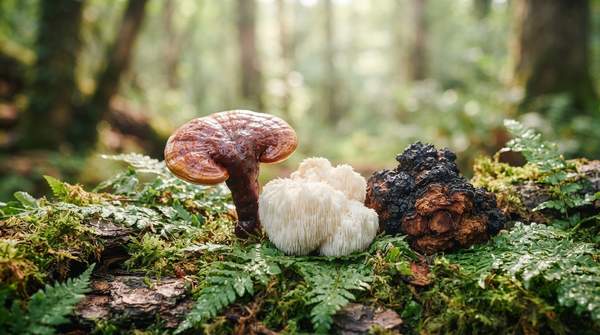
A piece of burnt toast has no business growing on the side of a birch tree. Yet that is roughly what Chaga looks like from a few steps away: a cracked, charcoal-black mass interrupting the pale bark. Beneath the rough exterior, the fungal material can be a striking rust-orange. Nature has clearly never felt obliged to make every mushroom look like a mushroom.
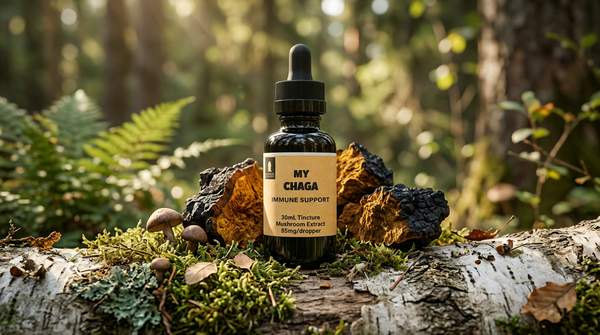
Chaga is exactly the sort of curiosity that suits My Mushroom, the locally owned Kamloops shop whose team describes itself as a small crew fascinated by fungi. The store’s MY CHAGA Immune Support Tincture gives the unusual birch-associated fungus a place in its functional collection. Its appeal begins with a story worth knowing, long before the conversation reaches a 30 mL bottle.
The Mushroom That Looks Like a Charcoal Lump
Chaga is associated with Inonotus obliquus, a fungus that develops on birch and some other broadleaf trees in northern environments. Its familiar black growth is a sterile conk, not the cap-and-stem fruiting body people typically associate with mushrooms. It can develop as the fungus grows within its host over many years.
The relationship is complicated. Inonotus obliquus is associated with decay of the wood inside the tree, sometimes described as heart rot. The black conk is the conspicuous clue to activity occurring beneath the bark. It is neither an ordinary tree burl nor a mushroom that simply appeared overnight after the rain.
The contrast is part of the fascination. Birch has light, papery bark; Chaga looks like a dark, deeply fractured intrusion. Even someone who would walk past a row of familiar brown mushrooms might stop at the sight of it. That first encounter often raises the best questions: What is it? Why is it there? And what exactly happens next?
The Story Continues After the Tree Dies
The conk is Chaga’s celebrity photograph, but the fungus has a much less familiar reproductive stage. Researchers have observed spore-producing structures developing beneath the bark after an infected birch dies. As those structures develop, they can crack and lift the bark, exposing surfaces that were previously hidden.
A 2024 study in Global Ecology and Conservation investigated this process in Estonia. The researchers described how the exposed wood on standing dead birches supports a distinct habitat and reported nearly 50 species of lichens and related fungi associated with those surfaces. Some belonged to groups of conservation concern.