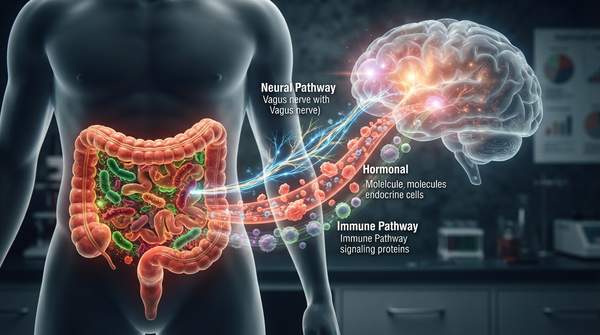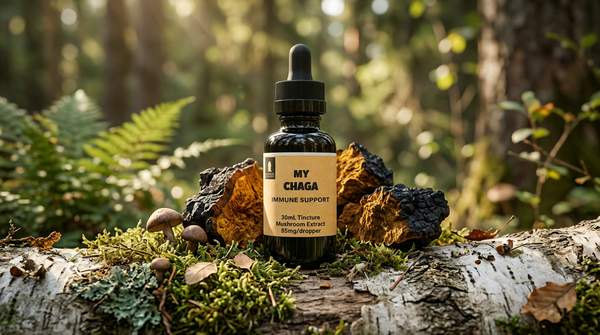
Adaptogenic mushrooms earn their name through chemistry, not folklore. The three most-studied species—Reishi (Ganoderma lucidum), Lion's Mane (Hericium erinaceus) and Chaga (Inonotus obliquus)—each carry distinct bioactive compounds that are understood to act on the body's stress machinery and immune pathways in different ways. Reishi's triterpenes and beta-glucans are proposed to modulate the HPA axis and immune cells directly; Lion's Mane works mainly through hericenones and erinacines that stimulate nerve growth factor; and Chaga's polysaccharides and triterpenes are associated with immune modulation and anti-inflammatory effects. Understanding which compound does what lets you see why these fungi are described as modulators rather than stimulants.
Understanding Adaptogens and the HPA Axis
The hypothalamic-pituitary-adrenal (HPA) axis is your body's central stress response system. When a stressor arrives—physical, emotional, hormonal, even something you ate—the hypothalamus signals the pituitary gland, which prompts the adrenal glands to release hormones such as cortisol. UCLA Health explains that experts believe adaptogens interact with this axis, which initiates the stress response and plays a major role in keeping the body in balance. In other words, the HPA axis is the command center adaptogens are thought to reach.
What makes an adaptogen an adaptogen, rather than just any calming or energizing herb? To qualify, a substance must be nontoxic at normal doses, support the whole body's ability to cope with stress, and help the body return to a stable state. That last criterion is the key one. Adaptogens are understood to work through the endocrine and immune systems to restore balance without overstimulation, as wellness educators at Bask Retreat Center describe it—helping the body regulate itself rather than forcing it in one direction.
This is why practitioners describe adaptogens as modulators. Dr. Michael Ruscio, a functional medicine clinician, notes that adaptogens appear to influence the stress response by supporting the HPA axis, modulating cortisol levels, and reducing oxidative stress and inflammation. In mushrooms specifically, he points to beta-glucans—a type of polysaccharide in fungal cell walls—as playing a major role. The principle holds broadly: adaptogens help the body maintain homeostasis rather than simply revving it up or shutting it down, though specific mechanisms vary by mushroom and compound. And as UCLA Health cautions, what experts know about most adaptogens is still limited.