A diet rich in fermented foods can increase the diversity of your gut microbiome and lower markers of inflammation — that is the central finding of a 2021 Stanford clinical trial, and it comes with an important catch. Not every product sold as "fermented" delivers live microbes to your gut. Some, like unpasteurized kimchi and yogurt with live cultures, carry both living bacteria and the beneficial compounds those microbes produced. Others, like sourdough bread, retain the byproducts of fermentation but lose the microbes themselves during baking. Understanding that distinction is the key to choosing foods that actually support gut health.
Understanding Fermented Foods and Your Gut Microbiome
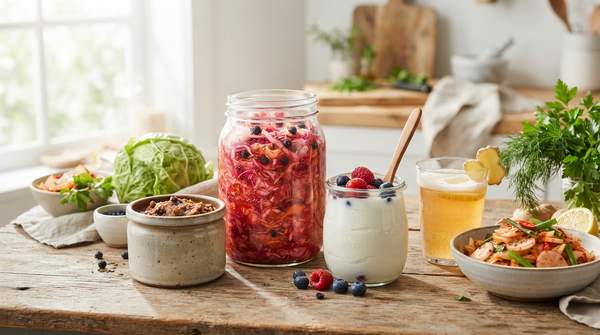
Fermented foods are made when microorganisms — most commonly lactic acid bacteria — transform the sugars and starches in raw ingredients into new compounds. Yogurt, kefir, kimchi, sauerkraut, fermented cottage cheese, and kombucha are all products of this process. What makes these foods interesting to researchers is not just their taste or preservation qualities, but the fact that they arrive in your body carrying two potentially useful things: the microbes themselves, and the chemical byproducts those microbes created during fermentation.
A scientific review of fermented foods and the gut microbiome concludes that these foods can affect the gut microbiome in both the short and long term, working either through compounds produced during fermentation or through interactions with microorganisms from the food that are capable of surviving gastrointestinal transit. That dual pathway — byproducts and surviving microbes — is the foundation for understanding why different fermented foods can have very different effects.
The Science-Backed Benefits: Diversity and Reduced Inflammation
The strongest recent evidence comes from a clinical trial conducted by Stanford researchers, in which 36 healthy adults were randomly assigned to a 10-week diet that included either fermented or high-fiber foods. The two diets produced different effects on the gut microbiome and the immune system. Participants eating foods such as yogurt, kefir, fermented cottage cheese, kimchi and other fermented vegetables, vegetable brine drinks, and kombucha tea saw an increase in overall microbial diversity — and the effect was stronger with larger servings.
"This is a stunning finding," said Justin Sonnenburg, an associate professor of microbiology and immunology involved in the research. The trial also found that the fermented-food diet decreased inflammatory proteins, an association between regular consumption of fermented foods and a reduction in inflammatory markers. The context matters here: low microbiome diversity has been linked in prior research to conditions such as obesity and diabetes, which is part of why an intervention that measurably increases diversity attracts attention.
Two qualifications keep this finding honest. The trial involved healthy adults over 10 weeks, so it does not establish benefits for people managing specific illnesses. And the study demonstrated an association between fermented food consumption and reduced inflammation within its design — it is strong trial evidence, but not a prescription for treating any condition.
How Fermented Foods Work: Live Microbes and Byproducts
The mechanism has two branches. The first is the microbes themselves. When live microorganisms from fermented food survive the journey through the stomach, they can interact with the gut's resident microbial community and may exert a physiological benefit through competition with pathogenic bacteria, according to a review of fermented foods and gastrointestinal health. This is one reason products that preserve live cultures are treated differently from those that do not.
The second branch is the metabolites. Even when the microbes are gone, fermentation leaves behind compounds that can affect health. Lactic acid bacteria — relevant to both dairy and non-dairy fermented foods — generate bioactive peptides and polyamines with potential effects on cardiovascular, immune, and metabolic health. Fermentation also produces immune-regulatory byproducts and can convert certain compounds in the original food into biologically active metabolites. These byproducts are sometimes called postbiotics, and they explain why a food can retain some value even after its live microbes are destroyed.
A practical illustration is sourdough bread. The bacteria and yeast that leaven sourdough cannot survive the high heat of baking, so the finished loaf does not deliver live probiotic microbes — but it still contains fermentation byproducts and prebiotic components. The baking step, not the fermentation step, determines what survives to your plate.
Fermented Food Classification: Live Microbes vs. Byproducts
The table below classifies common products by their key processing step and what that step leaves behind. The reasoning is straightforward: fermentation creates both microbes and byproducts; pasteurization and baking kill the microbes but leave many byproducts; and commercial large-scale products are often pasteurized for stability, sometimes with added microbes that may not have fermented the product itself.
| Product Example | Key Processing Step | Contains Live Microbes? | Contains Fermentation Byproducts? |
|---|---|---|---|
| Yogurt / Kefir | Fermented; dairy ferments typically list live bacterial species on the label | Yes, typically | Yes — lactic acid, bioactive peptides, polyamines |
| Unpasteurized sauerkraut / Kimchi | Fermented with complex microbial communities; no pasteurization | Yes, from the fermentation community | Yes — lactic acid and immune-regulatory byproducts |
| Pasteurized sauerkraut / Kimchi | Fermented, then pasteurized for shelf stability | Few or none — heat kills the microbes | Yes — byproducts survive pasteurization |
| Sourdough bread | Fermented, then baked at high heat | No — microbes cannot survive baking | Yes — byproducts and prebiotics remain |
| Kombucha | Fermented tea; included in the Stanford trial's fermented-food diet | Yes, when unpasteurized | Yes — fermentation metabolites |
One caution when reading labels: dairy ferments like yogurt and kefir typically list their live bacterial species, while sauerkraut and kimchi often do not, because they are made by complex microbial communities rather than a defined starter culture. The absence of a strain list on a jar of kimchi does not mean the product lacks live microbes — it usually reflects the nature of the fermentation. Conversely, a strain list on a pasteurized product does not guarantee the microbes are alive.
Making Informed Choices for Gut Health
The evidence supports a clear mental model. Fermented foods can influence the gut microbiome through two channels — surviving live microbes and fermentation-derived compounds — and a clinical trial in healthy adults showed that eating six servings a day of fermented foods increased microbiome diversity and reduced inflammatory markers, with stronger effects from larger servings. Processing determines which channel a given product uses: unpasteurized ferments deliver both; baked and pasteurized products deliver mainly byproducts.
This article is not medical advice, and it does not recommend specific products or brands. Microbial communities in fermented foods are also highly variable, so no product can be promised to contain a particular species. What the evidence does support is a way of reading the shelf: the processing method, stated on the label, tells you more about a product's likely contribution than the word "fermented" on the front.
Empowering Your Gut Health Choices
To maximize the potential gut health benefits, prioritize fermented foods that are unpasteurized and explicitly state they contain live and active cultures, or are known to retain fermentation byproducts even if microbes are absent. The measurable indicator to check is the presence of "live and active cultures" on product labels, or the absence of "pasteurized" on traditionally fermented products like kimchi and sauerkraut. That single label check separates the products most likely to deliver live microbes from those offering only byproducts — and it is a step you can take on your next grocery run.